
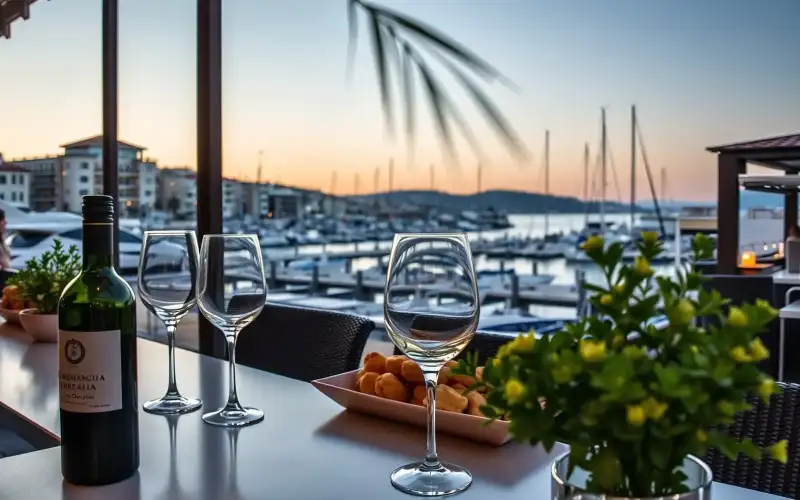
The sommelier at my hotel — a quietly authoritative Cypriot woman who had clearly fielded this question several hundred times — paused when I asked her where to drink the most interesting wine in the region. She didn't mention Keo. She didn't mention Loel. She put down her cloth, looked at me steadily, and said: "Go to the villages. The small ones. The ones without signs." That, it turned out, was the most useful piece of advice I received during ten days in Limassol.
Commandaria has the history — a wine with a documented lineage stretching back to the Crusades, probably the oldest named wine still in continuous production on earth. It deserves its reputation. But the story of Limassol wineries in 2026 is being written by people who are not trading on ancient credentials. It is being written in concrete tanks and amphorae, in vineyards planted with Maratheftiko and Xynisteri at 900 metres above sea level, by winemakers who trained in Burgundy or Stellenbosch and came home with something to prove.
Why the Troodos Foothills Changed Everything
The geography here is the key to understanding why boutique wine production has accelerated so dramatically in the past decade. The Troodos mountain range rises sharply from the coast, and within thirty to fifty kilometres of Limassol's marina, you gain altitude quickly. Villages like Omodos, Vouni, Lofou, and Arsos sit between 700 and 1,100 metres. The days are warm but rarely brutal; the nights drop considerably. That diurnal range — the swing between daytime heat and cool evenings — is precisely the condition that preserves acidity and aromatic complexity in grapes.
The soils are ancient and varied: chalky limestone in some plots, volcanic-influenced schist in others. Xynisteri, the indigenous white variety that makes up the backbone of most Commandaria blends, behaves very differently here than it does on the plains. Harvested late, it can produce wines with genuine texture and salinity. Maratheftiko, the red variety that requires cross-pollination to set fruit properly, is notoriously difficult to grow but produces deeply coloured, tannic wines with a wild, almost gamey quality that has no real equivalent in European viticulture.
The distance from Limassol city centre to most of these producers is manageable. Omodos is 42 kilometres via the B8 road — roughly 50 minutes in light traffic. Vouni and Arsos are slightly closer. None of this requires a full day's expedition, though I'd recommend treating it as one.
Vasilikon Winery, Omodos: The Benchmark
If you visit one boutique producer near Limassol, make it Vasilikon. The winery sits just outside Omodos village, a place that can feel overrun with tour coaches in high summer but quietens dramatically if you arrive before 10am or after 4pm. Vasilikon has been producing wine since 1993, but it is emphatically not a heritage operation coasting on longevity.
The current winemaker, who took over the cellar operation in 2019, has introduced extended maceration for the Maratheftiko and begun experimenting with partial ageing in local clay amphorae — a technique that adds an earthy, oxidative note without the vanilla interference of new oak. The results are striking. Their 2023 Maratheftiko Reserve has a nose of dried herbs, dark cherry, and something mineral and almost smoky; on the palate it's structured but not aggressive, with tannins that feel like velvet rather than sandpaper.
"We're not trying to make Bordeaux in Cyprus. We're trying to make Cyprus in Cyprus. That sounds obvious. It took us years to understand it." — Vasilikon winemaker, during a tasting, March 2026
The tasting experience is well organised without feeling corporate. The standard tasting (six wines, with local cheese and olives) costs €18 per person. A guided cellar tour with extended tasting runs to €35. Booking in advance is advisable from April through October. User ratings on major travel platforms hover around 4.7 out of 5, with consistent praise for the staff's knowledge and the absence of hard-sell pressure.
Zambartas Wineries, Agios Amvrosios: Precision and Restraint
Marcos Zambartas trained in Australia before returning to Cyprus, and the influence shows — not in the wines themselves, which are thoroughly Mediterranean in character, but in the precision of the operation. Zambartas Wineries is based in Agios Amvrosios, a village about 38 kilometres from Limassol, and it produces a relatively small annual volume that sells out with some regularity.
Their Xynisteri is the wine I keep thinking about. It is pale gold, almost watery in colour, but the aroma is anything but thin: white peach, fennel, a thread of beeswax, and a saline finish that makes you want to eat grilled fish immediately. At around €14 a bottle retail, it is also one of the better-value whites I encountered in Cyprus. The winery does not have a grand tasting room in the tourist sense — the experience is more intimate, more like visiting a working cellar than a hospitality venue, and that suits the wines exactly.
Tastings are available by appointment and cost approximately €20 per person for a flight of five wines. The winery is particularly well regarded among wine professionals; if you have any interest in the technical side of indigenous variety viticulture, the conversations here can run for hours.
Vouni Panayia Winery: Altitude and Ambition
At 1,100 metres above sea level, Vouni Panayia is one of the highest-altitude wineries in Cyprus, and the drive up to it — through pine forest, past stone-walled terraces, with the coast visible as a silver line far below — is part of the experience. The winery is a cooperative in origin but has reinvented itself substantially since the mid-2010s, investing in modern equipment while retaining old-vine Xynisteri and Maratheftiko plots that date back several decades.
The wines here have a different character from those lower down the mountain. There is a coolness and freshness to even the reds — the Maratheftiko has less body than Vasilikon's version but more perfume, more lift. Their white Alina, a blend of Xynisteri with a small percentage of Muscat of Alexandria, is unashamedly aromatic and works beautifully as an aperitif with the local meze.
The tasting room is open daily from 9am to 5pm between April and October, and by appointment November through March. A standard tasting costs €15. The drive from Limassol city centre is approximately 55 kilometres and takes around an hour, but the road conditions are good and the scenery justifies every minute.
What to Expect: A Practical Comparison
| Winery | Distance from Limassol | Tasting Cost | Booking Required | User Rating |
|---|---|---|---|---|
| Vasilikon (Omodos) | 42 km / ~50 min | €18–€35 | Recommended | 4.7 / 5 |
| Zambartas (Agios Amvrosios) | 38 km / ~45 min | €20 | Essential | 4.8 / 5 |
| Vouni Panayia | 55 km / ~60 min | €15 | Apr–Oct: walk-in; Nov–Mar: appointment | 4.6 / 5 |
| Linos Winery (Lofou) | 30 km / ~35 min | €12–€25 | Recommended weekends | 4.5 / 5 |
Linos Winery, Lofou: The Hidden One
Lofou is the village that feels most like a film set — cobbled lanes, carved stone doorways, bougainvillea in colours that seem digitally enhanced. Linos Winery operates out of a converted carob warehouse on the edge of the village, and it is the least visited of the four producers I'm highlighting here, which means the tasting experience has an unhurried quality that the more famous names can struggle to replicate in peak season.
The winemaker at Linos is young — mid-thirties, trained partly in Montpellier — and the wines reflect a willingness to experiment that is both exciting and occasionally uneven. Their skin-contact Xynisteri (an orange wine, essentially) is polarising: deeply amber, tannic for a white, with a dried-apricot and chamomile character that either captivates or confuses depending on your palate. I found it fascinating. A friend who prefers Chablis found it alarming. Both reactions seem valid.
The standard tasting at Linos costs €12 for four wines, rising to €25 for a premium flight of seven that includes the library releases. The village itself is worth an hour of wandering before or after the tasting — there is a small taverna serving lunch until 3pm that does an exceptional kleftiko.
How to Build a Winery Day from Limassol
The practical question is how to combine these visits without either rushing or arriving at the last one in a state of pleasant incapacity. My recommendation, based on trial and considerable error:
- Start early. Leave Limassol by 9am. The light in the foothills before 11am is extraordinary, and you beat the tour coaches to Omodos.
- Begin with Linos in Lofou — it's the closest, at 30 kilometres, and the lighter, more experimental wines work better as an opener than as a finale.
- Move to Zambartas in Agios Amvrosios for late morning. This is the most technically demanding tasting; your palate will be freshest.
- Lunch in Omodos village — To Anoi taverna does a reliable meze for around €18 per person — before the afternoon session at Vasilikon.
- Save Vouni Panayia for a separate day if possible. The altitude and the drive merit their own expedition.
- Arrange a driver or use a dedicated wine tour operator based in Limassol. Several operate out of the marina area, with full-day tours typically priced between €75 and €120 per person including transport.
The wines of the Troodos foothills are not yet famous in the way that Burgundy or Barossa are famous. That is, for the moment, entirely to the visitor's advantage.
A Note on Commandaria — and Why It Still Matters
None of what I've written above is intended to diminish Commandaria. The great sweet wine of Cyprus — made from sun-dried Xynisteri and Mavro grapes in the fourteen designated villages of the Commandaria appellation — remains one of the Mediterranean's most singular drinking experiences. A well-aged Commandaria from Kyperounda or from the KEO cooperative has a complexity that rewards slow, attentive sipping: dried figs, carob, orange peel, a warmth that spreads rather than burns.
The point is simply that Commandaria is not the whole story. The boutique producers working with the same indigenous varieties, in the same ancient landscapes, are producing dry table wines that deserve equal attention. They are doing it with relatively small budgets, considerable ingenuity, and a seriousness of purpose that comes through in every glass. The wine world is beginning to notice. Prices will not stay where they are indefinitely.
If you are staying in Limassol — at one of the marina hotels, or in the old town, or out along the coastal strip — the Troodos wine villages are close enough to visit without sacrifice and far enough away to feel like genuine discovery. Take the sommelier's advice. Go to the small ones. Go before the signs appear.
Comments (3 comments)