
The Morning I Nearly Missed the Harvest
It was 6:47 a.m. on a Tuesday in October 2024 when I realised I'd been cycling through Limassol's wine country for fifteen years without ever timing a ride to coincide with the actual picking. The sun hadn't yet burned through the morning mist clinging to the Akamas slopes, and I was standing outside Keo Winery's gates with my bicycle propped against the stone wall, watching workers in faded blue shirts move between the rows with practiced efficiency. One of them—a woman named Maria who'd been harvesting grapes since 1987—waved me over and handed me a bunch of Xynisteri grapes still warm from the vine. That moment crystallised something I'd been circling around for months: autumn cycling through Limassol's vineyards isn't just about the scenery or the physical challenge. It's about timing yourself to witness the transformation of a landscape that only reveals itself fully during harvest season.
By autumn 2026, this experience has become even more accessible. The wine tourism infrastructure around Limassol has expanded, rental shops have multiplied, and the routes themselves have been refined through years of feedback from cyclists and winery operators. Yet the fundamental magic remains unchanged—you're moving through a working agricultural landscape at exactly the moment when it matters most.
Understanding Limassol's Wine Geography and Seasonal Rhythms
The Terroir That Shapes Your Route
Limassol sits at the crossroads of three distinct wine-producing zones. To the north, the Troodos foothills rise sharply, where altitude and cool nights create conditions for Xynisteri and Maratheftiko varieties. To the west, the Akamas peninsula's limestone soils produce fuller-bodied reds. To the east, the sprawling flatlands around Erimi and Kalo Chorio favour high-volume production and newer experimental plantings. Understanding this geography matters because it determines not just which wines you'll taste, but the difficulty profile of the routes themselves.
Autumn in Limassol doesn't arrive on a fixed date. Harvest typically begins in late August for early-ripening whites and stretches into October for the slower-maturing reds. By mid-September 2026, you'll find activity at most major wineries. By late October, the season is winding down, though the landscape remains spectacular—the leaves on the vines shift from green to amber, and the morning light takes on that particular golden quality that makes photographers weep. Temperature swings are dramatic: early morning rides in October can see you starting at 12°C in shorts and reaching 28°C by noon.
Why Autumn Beats Every Other Season
Spring is pleasant but lacks the energy of harvest. Summer is brutally hot—I've cycled Limassol's wine routes in July, and you're essentially moving between air-conditioned tasting rooms like a desperate tourist. Winter brings occasional rain that can make the unpaved sections treacherous. But autumn? The combination of moderate temperatures, visible harvest activity, and the psychological shift in the wine community creates something irreplaceable. Winemakers are focused and energised. Vineyard workers are everywhere. The smell of fermentation drifts across the landscape. You're not observing wine culture—you're cycling through it at its most vital moment.
Four Routes for Different Fitness Levels and Interests
Route One: The Coastal Approach (Beginner, 28 km, 2-3 hours active cycling)
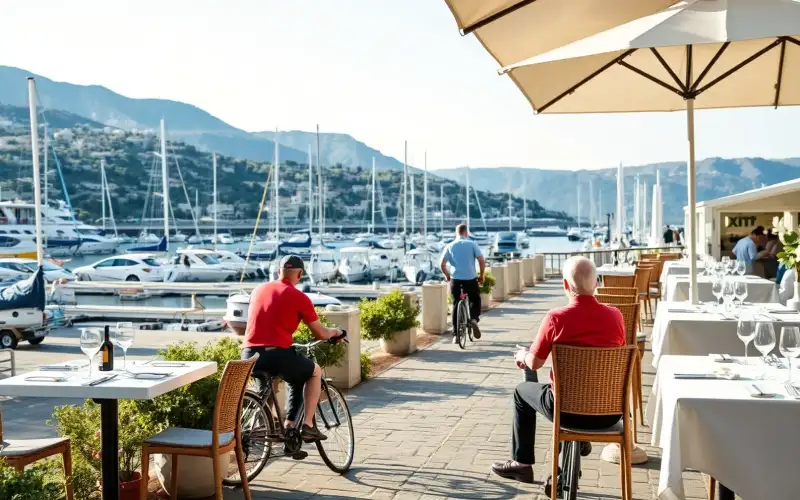
This route starts at Limassol Marina and follows the coast eastward toward Amathus before turning inland toward the Erimi wine cluster. It's the gentlest option, with minimal elevation gain and the psychological comfort of never being far from the main highway. The surface is entirely paved, and you'll pass through the Amathus archaeological zone before the landscape shifts to vineyards around the 12 km mark.
The winery stops here are geared toward tourism. Tsangarides Winery, located just off the main road near Erimi, offers informal tastings and a small shop. They're accustomed to cyclists and will let you leave your bike in their courtyard. Continue to Fikardos Winery, another 4 km inland, where the owner—a former hotel manager named Nicos—has deliberately positioned his operation as cyclist-friendly. He stocks electrolyte drinks, has a shaded tasting area, and his wife makes excellent savoury pastries that pair surprisingly well with young Mavrud.
The return follows the same route, but you'll notice the light has shifted dramatically by late afternoon. October rides often include that surreal moment around 4:30 p.m. when the sun drops behind the Akamas and the entire landscape turns copper-coloured for about twenty minutes. It's worth stopping somewhere around the Amathus turn to witness this.
Route Two: The Foothills Loop (Intermediate, 42 km, 4-5 hours including stops)
This is the route I recommend most often to visiting wine enthusiasts with moderate fitness. It climbs gradually into the Troodos foothills, loops through the heart of the traditional wine-producing villages, and returns via a different valley. The elevation gain is roughly 600 metres spread across 42 kilometres, so the gradient never exceeds 6 percent, but you'll feel every metre by the end.
Start from Limassol town centre (near the Old Port) and head north on the Paphos Road, turning east toward Yermasoyia around the 8 km mark. The road climbs gently through suburban sprawl before opening into vineyard landscape around Kalo Chorio. By 15 km, you're genuinely in wine country. The villages of Koilani and Trimiklini sit at roughly 400 metres elevation—not high, but enough to create noticeably cooler conditions and different microclimates.
Stop at Kyperounta Winery, a family operation run by three siblings who took over their parents' vineyard in 2019. They've invested in modern equipment but retained traditional fermentation methods for their Xynisteri. The tasting room overlooks their own vineyard rows, and in October, you'll watch the harvest happening literally below you. Their Mavrud reserve—aged in French oak for eighteen months—is exceptional, though at €28 per bottle, it's a serious wine, not a casual tasting-room pour.
The return route descends through Pera Pedi and loops back toward the coast via Monagroulli. This section is where you'll encounter the most unpaved sections—roughly 8 km of well-maintained gravel that's perfectly rideable on a hybrid or gravel bike, though you'll want to be cautious after rain. The final 10 km are paved and relatively flat, following agricultural roads back toward the coast.
Route Three: The Mountain Challenge (Advanced, 56 km, 6-7 hours including extended stops)
This route climbs higher into the Troodos foothills, reaching elevations around 700 metres and incorporating steeper sections suitable only for experienced cyclists with reasonable fitness. It's not a professional cycling route—there are no Tour de France gradients here—but it demands respect and proper preparation.
The route begins identically to Route Two but diverges near Kalo Chorio, heading instead toward the village of Silikou. The climb from Silikou toward Trimiklini is the route's most challenging section: 4 km at an average 7 percent gradient, with several sections touching 10 percent. It's relentless but never catastrophic. By October, you're doing this in temperatures that make the effort manageable—try this same route in July and you're risking heat exhaustion.
The payoff is access to smaller, family-run wineries that rarely see cyclists. Vlasides Winery, perched at 650 metres, produces only 12,000 bottles annually, mostly Xynisteri and experimental Riesling plantings. The owner, Petros, is a former geologist who can talk for hours about soil composition and microclimate. His wines are rarely exported—you're essentially tasting something you cannot obtain anywhere else. A bottle of his 2023 Xynisteri costs €15 and tastes like concentrated autumn mornings.
The descent on the return is thrilling. From Trimiklini back toward the coast, you drop roughly 500 metres over 18 km, which creates long, flowing sections where you barely need to pedal. This is where you'll understand why locals say autumn cycling here is addictive—the effort on the way up is repaid with pure flow on the way down.
Route Four: The Akamas Peninsula Wine Trail (Intermediate-Advanced, 48 km, 5-6 hours)
This western route is less travelled by visiting cyclists, which makes it special. It explores the Akamas peninsula's wine-producing villages—Polis, Latchi, and the inland settlements—and incorporates some genuinely remote vineyard landscapes. The surface is mixed: roughly 60 percent paved, 40 percent well-maintained gravel. Wind can be a factor, particularly in the afternoon when the sea breeze picks up.
Start from Paphos and head south toward Polis, following the coastal road. Around the 12 km mark, turn inland toward the wine villages. Latchi Winery, located in the village of the same name, is worth the detour. They specialise in Mavrud and Cabernet Sauvignon blends, and the tasting room has views toward the Mediterranean. Their 2021 Mavrud reserve—aged in French oak—is serious wine at €26 per bottle, but the regular Mavrud at €12 is excellent value and represents the terroir more authentically.
The landscape here is wilder than the foothills routes. You'll cycle through sections where vineyards abut scrubland, and the villages themselves feel less touristy. The gravel sections are firm and rideable, but you'll want a hybrid or gravel bike rather than a road bike. By late October, the light here is extraordinary—the combination of westward-facing slopes and Mediterranean light creates golden hour that lasts from 3:30 p.m. until sunset.
Practical Essentials: Equipment, Rentals, and Attire
Choosing Your Bike and Where to Rent
Limassol has three major bike rental operations as of autumn 2026. Cyclemania, located near the marina, rents hybrid bikes (€18/day), gravel bikes (€24/day), and road bikes (€22/day). Their stock is well-maintained, and they offer basic repair kits with every rental. Pedal Power, in the Old Town, specialises in higher-end equipment—carbon road bikes at €35/day, premium gravel bikes at €28/day. They're more expensive but the bikes are newer and better-suited to serious cyclists. Cyprus Cycles, a smaller operation in Yermasoyia, focuses on family rentals but also has solid hybrid bikes suitable for mixed-surface routes.
For Routes One and Two, a hybrid bike is ideal—versatile, comfortable, and forgiving on occasional rough sections. For Route Three, you'd prefer a gravel bike with wider tyres for the unpaved sections. Route Four definitely demands a gravel bike; road bikes will struggle on the rougher sections. All three rental shops offer helmet hire (included with bike rental) and basic lock and light packages (€3-5 additional).
Clothing and Preparation for Autumn Conditions
October in Limassol is deceptive. Early morning temperatures hover around 12-14°C, but by noon you're at 26-28°C. Dress in layers: a lightweight base layer, a thin jersey, and a packable windbreaker that you can remove and stow as the day warms. Cycling-specific clothing isn't essential—I've seen visitors cycle these routes in regular athletic wear—but padded shorts make a significant difference on longer routes. Bring at least 1.5 litres of water capacity (a hydration pack or two water bottles), sunscreen (SPF 30 minimum; the October sun is still intense), and a basic repair kit (spare tube, tyre levers, pump).
Footwear matters more than most people realise. Cycling shoes aren't necessary, but trainers with good grip and ankle support are. The unpaved sections on Routes Three and Four can be loose, and you'll appreciate the stability. Avoid sandals and flip-flops entirely—I've seen too many visiting cyclists struggling on gravel in inappropriate footwear.
Timing Your Ride: The Harvest Calendar and What You'll Witness
Early Autumn (Late August to Mid-September)
If you're visiting in late August or early September 2026, you'll catch the beginning of harvest. The early-ripening white varieties—Xynisteri, Sauvignon Blanc, Riesling—are being picked. The landscape is still predominantly green, but you'll see activity in the vineyards. Winery operations are in full swing, and the smell of fermentation is beginning to permeate the air. Temperatures are still warm (25-30°C), so early morning starts around 6:30 a.m. are advisable.
Mid-Autumn (Mid-September to Early October)
This is the optimal window for cycling. The red varieties—Mavrud, Cabernet Sauvignon, Syrah—are being harvested. Temperatures are moderate (20-26°C), and the landscape is visibly transforming. Vine leaves begin shifting colour. The fermentation activity is at its peak, and you'll encounter the most vibrant energy in the wineries. Most winery tasting rooms are open and staffed, though some smaller operations may ask you to call ahead.
Late Autumn (Early to Late October)
By late October, harvest is winding down, though some wineries continue into early November. The landscape is spectacular—vine foliage has shifted to amber and copper tones. Temperatures drop (16-24°C), and you'll need that windbreaker. The advantage is that the crowds diminish, and you'll have a more intimate experience at wineries. The disadvantage is that some smaller operations may have reduced hours or be closed for cleaning and maintenance.
Winery Etiquette and What to Expect
Arriving at a winery by bicycle creates a particular dynamic. You're clearly not a casual tourist—you've made an effort. Most winery operators appreciate this and are generous with their time. However, a few practical considerations matter. Call ahead to larger wineries if you're arriving in a group of more than four cyclists. Smaller family operations often don't expect cyclists and may not have tasting facilities ready. Always ask permission before leaving your bike in their courtyard or tasting room.
Expect to spend €8-15 per person for a tasting (typically three to five wines). Some wineries waive the tasting fee if you purchase a bottle. Bring cash—many smaller operations don't accept cards. Respect the harvest schedule; if workers are actively picking, don't expect extensive tours or long conversations with the winemaker. The work comes first, and visitors are a secondary consideration.
One crucial point: don't cycle after tasting wine, particularly if you've sampled multiple wineries. What feels like moderate alcohol consumption—three glasses spread across an afternoon—impairs your judgment and reaction time more significantly when you're fatigued from cycling. Plan your route so your final winery stop is near your endpoint, and consider using a taxi for the return journey if you've tasted extensively.
The Deeper Rewards Beyond the Physical Challenge
After sixteen years of cycling Limassol's wine country, I've learned that the real value isn't in checking off routes or accumulating tasting notes. It's in the conversations that happen when you arrive at a winery on a bicycle, slightly sweaty and genuinely interested in what's happening in the vineyard. A winemaker who might give a tourist a five-minute explanation will spend forty-five minutes with a cyclist, discussing soil composition, fermentation temperatures, and why they chose to plant Riesling in a particular microclimate.
It's in noticing how the landscape changes year to year—how a vineyard you cycled past in 2024 has been replanted with different varieties in 2025, how weather patterns shift the harvest dates, how individual winemakers experiment with techniques. It's in the physical sensation of effort and recovery, of climbing a steep section and feeling your legs burn, then descending into a valley where the air temperature drops five degrees and the smell of fermentation grows stronger.
Autumn 2026 offers unprecedented infrastructure for this experience. The routes are well-established. The rental options are abundant. The wineries are accustomed to cyclists. But the fundamental experience—moving through a working agricultural landscape at the moment when it matters most, stopping to talk with people who've dedicated their lives to understanding soil and climate and fermentation—that remains unchanged and irreplaceable.

Comments (4 comments)